From the team
Button
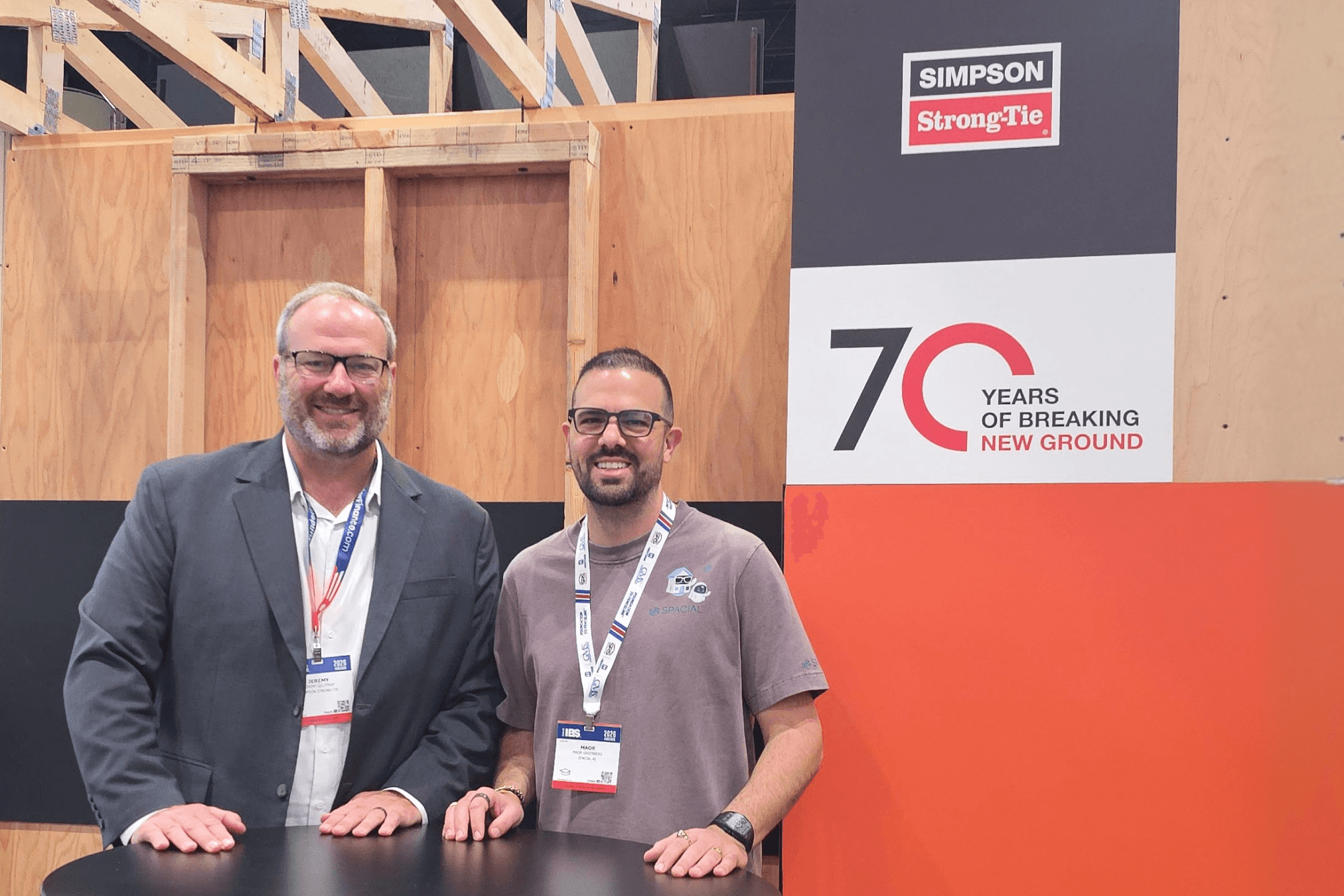
At IBS, we sat down with Jeremy Gilstrap, Executive Vice President, Innovation at Simpson Strong-Tie, to talk about a problem builders run into constantly: you want more glass, bigger doors, and cleaner elevations, then the lateral system forces the layout back into reality.
This is the gap Strong-Wall shearwalls are built to close.
The real constraint is not the architecture
On paper, most homes look straightforward. In the field and in plan check, the pain shows up in the same place: narrow wall segments, stacked conditions, and openings that leave you with very little room to develop shear capacity.
That is where “just use conventional shear walls” stops being a clean answer. The moment the wall gets too narrow, you start paying for it in redesign time, foundation changes, and another round of coordination.
What Strong-Wall shearwalls solve
Strong-Wall shearwalls are pre-engineered shearwall solutions that help you carry lateral loads when conventional wood shear walls are constrained by geometry.
Simpson Strong-Tie’s Strong-Wall Shearwall Selector is designed to help designers select an appropriate solution in line with current code requirements.
Practically, this is what the tool and the system do well:
Help you evaluate shearwall options early, before the set gets “final.”
Provide engineered outputs, including drift and uplift values, so you are not guessing.
Support designs where you need high capacity without giving up the openings that sell the home.
Steel vs wood, the builder level view
In the conversation, the comparison came down to tradeoffs you already live with:
Steel Strong-Wall shearwalls can be a strong fit when you need high capacity in a tight footprint and you want a more standardized solution for specific heights and configurations.
High-strength wood Strong-Wall shearwalls are often used when you want a wood-based solution and more flexibility by condition.
If you want the official product families and where they fit, Simpson Strong-Tie’s Strong-Wall selector content and tool references the Strong-Wall categories and types.
The part people underestimate: anchorage and foundation coordination
Strong-Walls are not “drop-in and done.” The wall is only one part of the load path.
In plain terms, the success of the detail depends on:
Hold-down and anchorage coordination
Foundation type and reinforcing assumptions
Uplift, overturning, and stacked effects
Clarity in the drawings so the field does not improvise
Simpson’s Strong-Wall tool explicitly frames this as engineered design, and includes analysis behavior around drift, uplift, distributed shear, and stacked configurations.
What we are building at Spacial
This is where our world intersects with Strong-Tie’s.
Builders do not lose time because the physics are hard. They lose time because the set is missing decisions, missing details, or missing coordination between structural intent and what actually gets built.
Our goal is to make the structural set more complete earlier, so plan check and field coordination get easier, not noisier. That means:
Surfacing lateral constraints earlier in the workflow
Driving clearer detailing in the permit set
Reducing rework caused by late structural changes
Want to Learn More?